Is Your Racket Actually the Problem, or Are You Just Late to the Shuttle?
You just missed another smash. The ball landed weakly in the net. You look at your racket and think: "This thing has no power. I need an Astrox 100ZZ."
But here's the uncomfortable question you should ask instead:
"Did I actually hit that shuttle at the right time and place?"
In 9 out of 10 cases, the problem isn't your equipment. It's that you arrived late to the shuttle and were forced to hit a compromised shot. Let's figure out which category you fall into.
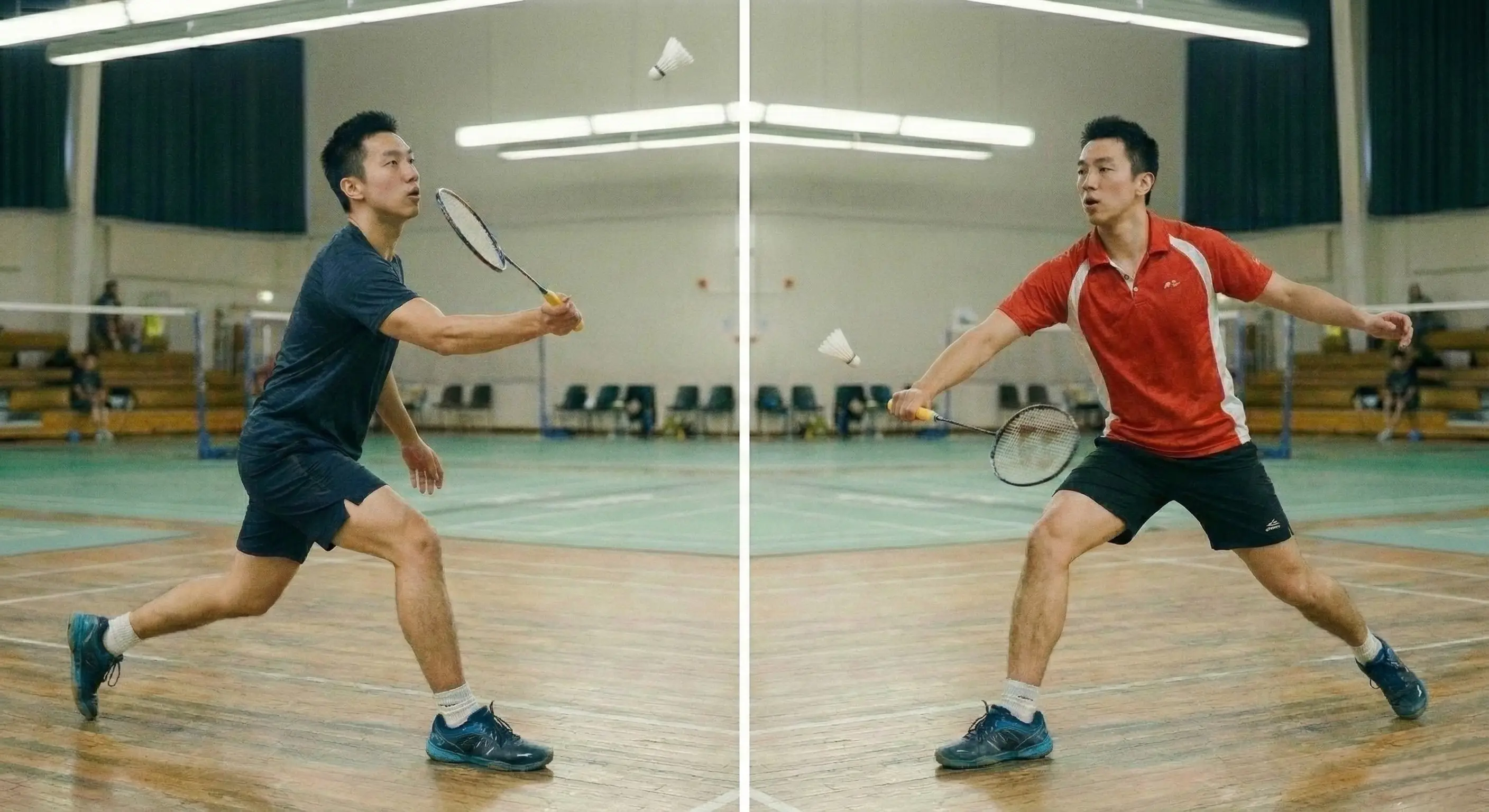
The "Late Player" Epidemic
Being "late" doesn't mean you miss the shuttle entirely. It means you hit the shuttle in a suboptimal position:
- Too low: You hit it at waist level instead of shoulder level (smash becomes a drive).
- Too far: You're reaching with a straight arm instead of a bent elbow (power gone).
- Too close: The shuttle jams into your body (awkward contact).
In all these cases, your technique breaks down. And when technique breaks down, you blame the racket.
The Honest Self-Diagnosis Test
Answer these questions honestly. If you answer "Yes" to 2 or more, the problem is timing—not your racket.
🔍 The 5-Question Test
- When you smash, do you often hit the shuttle below shoulder height?
- Do you frequently "reach" for shots with a straight arm?
- After hitting a shot, are you still moving (instead of balanced and ready)?
- Do stronger/faster opponents make your shots feel weaker (same racket)?
- Do you feel "rushed" during rallies more often than "in control"?
Result:
What "On Time" Actually Looks Like
When you arrive on time to a shuttle:
| Body Part | On Time | Late |
|---|---|---|
| Arm | Elbow bent at 90°, racket behind you | Arm straight, reaching forward |
| Contact Point | In front of body, slightly to the side | Directly above head or behind body |
| Feet | Stable, weight transferring forward | Still shuffling, unbalanced |
| Swing | Full, relaxed follow-through | Abbreviated, "punchy" swing |
If you can identify with the "Late" column, buying a new racket is like buying a faster car when you don't know how to drive.
When the Racket IS the Problem
There are legitimate cases where your equipment is holding you back. Here's how to know:
- You consistently hit early: You arrive with time to spare, but your shots still lack depth or power. You can "feel" the flexible shaft bending too much.
- You want higher tension: Your control is excellent but the strings feel "bouncy." You want to go to 27lbs+, but your racket maxes out at 24lbs.
- You have a defined style: You've played for 2+ years and know you are a power player or a control player. Your "all-rounder" beginner racket doesn't amplify your strengths.
The 30-Day Footwork Challenge
Before buying anything, try this challenge for 30 days:
- Split step every single rally. No exceptions.
- Watch your opponent's racket, not the shuttle.
- Ask yourself after each shot: "Was I balanced when I hit that?"
If after 30 days you are still unsatisfied with your power and control, then consider an upgrade. But I predict most of you will realize the racket was never the problem.
Conclusion
The best racket in the world cannot compensate for late arrival. It cannot create power out of poor positioning. Before you spend $200, spend 30 days fixing your footwork. It's free, and it might just change your game more than any graphite technology ever could.
Related Reading:
Should You Buy Gear or Practise More? →